Soft foot: the misalignment you cannot see until the motor is bolted down
A soft foot is a machine foot that does not sit flat on its baseplate. It is the most common reason a careful alignment is lost between the moment the readings are taken and the moment the last hold down bolt is torqued. As the bolts go in, a distorted motor frame lifts, twists or bends the shaft, and the alignment that was inside tolerance ten minutes earlier no longer is.
Soft foot correction is not a separate inspection to be scheduled for another day. It belongs at the front of the alignment process, before any final alignment values are recorded, and it is built into ROBOTALIGN as a dedicated program. This guide covers what the condition is, why it happens, how it is measured and what correcting it involves.
What a soft foot does to a machine
An electric motor frame is stiff, but it is not infinitely stiff. When one corner of the frame is pulled down onto a baseplate that the other three feet do not agree with, the frame bends. The bend shows up as a change in shaft height, a change in the angle of the shaft, or both. Either way the coupling is now asked to absorb a misalignment created by the bolts rather than by the layout of the machinery.
On a 1800 rpm motor a few thousandths of an inch of movement at the coupling is enough to show up as vibration at the bearings, and it repeats every time the machine is worked on because the condition was never measured. It is one of the reasons a drive train can be rebuilt, aligned and still run rough.
The four conditions that get called soft foot
Parallel soft foot
One foot sits above the baseplate and stays there. Tightening the bolt pulls the frame down at that corner, and the motor housing distorts by roughly the gap you had to close.
Angular soft foot
The foot is not square to the baseplate, so it touches along one edge and rocks across the face. The frame twists as the bolt loads the high side, and the reading changes again at the next bolt.
Squishy soft foot
The foot touches, but the support under it does not. A bent shim stack, a corroded shim, a cracked grout pad or a soft baseplate compresses under bolt load and lets the corner settle after the alignment is signed off.
Induced soft foot
The feet are flat and the baseplate is flat, but piping strain, a rigid conduit connection or a bolted guard pulls the housing out of shape. Loosen the pipe and the foot lifts off the plate.
How soft foot is measured
The classic check is a feeler gauge. All four bolts are loosened, each bolt is tightened in turn while the other three stay free, and the gap that opens under the loose feet is measured and written down. A foot that reads more than a few thousandths of an inch is a candidate for correction, and many plants work to a limit of around 0.002 to 0.003 inches per foot. The sequence matters as much as the number: measuring with the other bolts tight hides the interaction between corners.
A laser alignment system with a soft foot program does the same job with the measuring units already mounted on the shafts, recording the movement of the shaft at each bolt position instead of a gap under a foot. Readings are logged per foot, the program works out which feet are high and by how much, and the technician gets a shim target for each corner rather than a set of numbers to interpret.
Correcting the condition
Correction usually means shims under the high foot, and it should mean clean, flat, uncut shims of the fewest pieces possible, because a stack of thin shims is itself a squishy foot. Where the baseplate is the problem, the answer is a baseplate repair or a machined pad rather than a thicker shim. Induced soft foot is corrected at the source, by loosening piping, correcting a conduit run or re-plumbing a rigid connection so the housing is not held in a bind. After the correction the check is repeated, because correcting one corner routinely changes the readings at the others.
How ROBOTALIGN handles soft foot
ROBOTALIGN includes a Soft Foot Correction Program that runs as part of the alignment sequence on the control unit. The Fowler Sylvac fiber optic measuring units watch the shaft while each bolt is worked, the program reports the movement of each foot, and it states the correction needed before the system moves on to horizontal, angular and parallel alignment. Because the same system then positions the motor for the technician, the correction and the alignment happen in one pass rather than in two separate visits to the machine.
For a plant running a scheduled outage, the practical gain is time and repeatability. The check that used to be done with a feeler gauge by whoever was available is now part of the alignment record, and the machine is signed off with the coupling in tolerance with every bolt tight, at operating temperature, and with the soft foot condition either corrected or documented.
Talk through a machine
If a drive train keeps coming back rough after an alignment, soft foot and piping strain are the first two things to rule out. Call Harris Technology directly to discuss a specific machine, or read the alignment guide for the measurement side of the process.
Soft foot questions from the plant floor

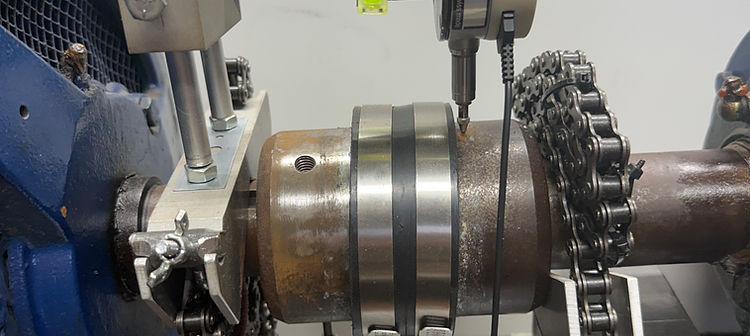
ROBOTALIGN measures and calculates it. The Soft Foot Correction Program records the shaft movement at each bolt position while the bolts are worked, identifies which feet are high and by how much, and states the shim correction needed. Installing the shim, repairing the baseplate or loosening the piping is physical work on the machine, so that part stays with the technician, but the measurement and the arithmetic no longer do.
You can, and the readings will be wrong. If a foot is high or the baseplate is twisted, the shaft moves as the hold down bolts are torqued, so the alignment recorded with the bolts loose is not the alignment the machine runs at. The soft foot check has to come first, and it has to be repeated after the correction because fixing one corner changes the other three.
It can. Thermal growth changes the height and angle of the feet as the machine reaches operating temperature, and a baseplate that was flat when cold can move when warm. Piping that was loosened for the correction can be re-tightened in a way that reintroduces strain. That is why the alignment record should include a hot check, and why dynamic stability matters more than a single cold reading.
Many plants work to a limit of about 0.002 to 0.003 inches per foot, roughly 0.05 to 0.075 mm, and treat anything above that as a correction. Below that, the frame distortion is small enough that the effect on the coupling is inside normal alignment tolerance. Higher speed machines and machines with long, flexible frames are less forgiving than that rule of thumb suggests.
Four things account for most of it: a foot that sits above the baseplate, a foot that is not square to the plate and rocks on one edge, a shim stack or grout pad that compresses under load, and piping or conduit strain that pulls the housing out of shape. Wear, corrosion, a repaired baseplate and a re-machined foot all show up the same way, as a gap or a movement at one corner.